
MILLER-BRADFORD HOUSE

The Miller-Bradford House was originally a modest home built by Samuel Miller, c. 1839. It was enlarged by Dr. Charles Bradford in the early 1840s. Dr. Bradford had come to Arrow Rock in 1840 and married a granddaughter of Dr. John Sappington. Bradford added rooms to the back, and a slave kitchen was attached to the house, creating two stories at the rear with a walkout basement. The original walnut siding still exists. In 1957, Bill and Cora Lee Miller purchased the property. It was a great honor when Friends of Arrow Rock received the gift of the Miller-Bradford House.
SHEBY LOG CABIN

Shelby Log Cabin is a common style log cabin of the early part of the 19th century. Logs were “squared” and placed one upon another. Clapboards were placed on the outside to protect the logs from weather and to provide additional insulation. In this case, walnut siding was used with a linseed oil applied for protection. Lathe and plaster were often added to the inside walls. This log cabin was built in 1835. This structure was donated to the Friends of Arrow Rock by Roberta Lanier (Cordell) Smith, a great-granddaughter of its builders, Richard and Rebecca Shelby. The building was taken down log-by-log and reconstructed where it now stands by 86-year-old master carpenter J. Logan Buntin.
JOHN P. SITES HOUSE

The downstairs of the John P. Sites House dates from the 1830s, when it was built as a Federal-style cottage. Johnny and Nannie Sites bought the house in 1866, and by the mid-1870s, they had remade it into a country Victorian home. They raised the roof and added two bedrooms upstairs and a more elaborate front porch. Friends of Arrow Rock has focused on furnishing the home with the kinds of items that would have been available in early Arrow Rock. Successful restorations of both the Sites Gun Shop and House earned the Friends of Arrow Rock the Albert B. Corey Award, the highest national award given a local historical organization by the American Association of State and Local History
JOHN P. SITES Jr. GUNSMITH SHOP

Young Johnny Sites journeyed with his family to Cole County, Missouri and then on to Boonville where his father plied his gunsmithing skills. It was from his father that Johnny learned his trade. In 1844, at age 23, Johnny Sites moved to Arrow Rock where he became the town’s gunsmith and one of the most skilled artisans in the country. At the John P. Sites Jr. Gunsmith Shop, you could have your rifle repaired, converted from a flintlock to a percussion rifle, or buy the indispensable balls, lead, powder and caps to fire it. Tyler Sydebotham is now demonstrating historic 19th-century traditional gunsmithing in the Sites Gunsmith Shop.
FAR OFFICE/SHOP, POST OFFICE BUILDING
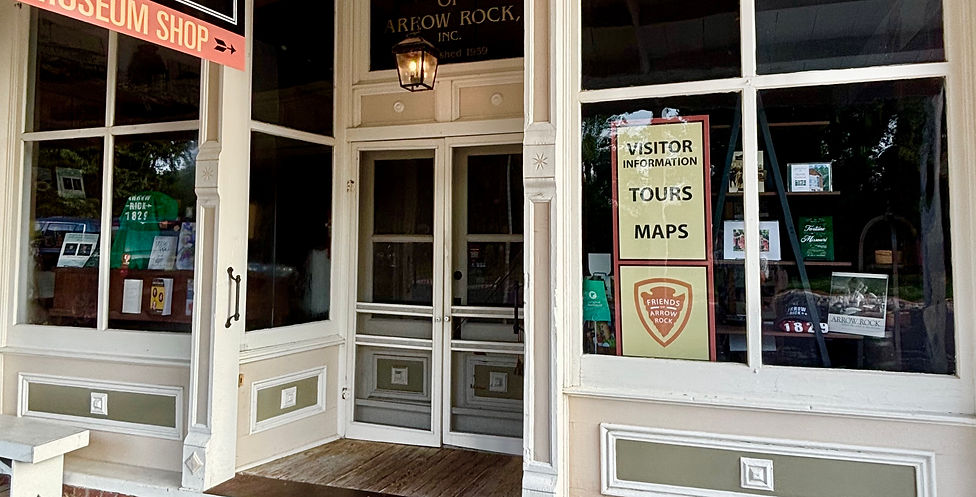
Along the block of storefront buildings known as “the boardwalk,” you will find the Friends of Arrow Rock headquarters and the town’s post office. Designed by architect Stuart Hutchison, these buildings carry out the early 1900s feel. The Friends of Arrow Rock office, which was the Arrow Rock Stock Bank from 1904 to 1927. This building houses the Christopher Collection of Early Missouri Firearms.‘ The first buildings on this block were built in the 1850s. They housed millinery shops, drug stores, banks, dry goods stores, groceries and other mercantile establishments to supply a bustling frontier town of nearly 1,000. A fire in 1901 destroyed this block; the buildings that were rebuilt are what you see today.
MASONIC LODGE BUILDING

The Arrow Rock Masonic Lodge #55 was established in 1842, and this two-story lodge hall was erected in 1868. The upper story was reserved as meeting space for the Masons and the ground floor was made available for rental, to generate income for the local Masonic chapter. On Nov. 14, 1960, a group of local women organized the Arrow Rock Craft Club to “promote Arrow Rock and make and sell homemade articles of any kind you would think would interest a stranger coming into our town.” Many of the charter members of the craft club were wives of Masons, and in 1961, they persuaded their husbands to lease them the vacant ground-floor space of the Masonic Lodge Hall.
ODD FELLOWS LODGE BUILDING

The Arrow Rock Chapter of Odd Fellows built its lodge hall in 1868 (the same year as the Masonic Lodge Hall directly across the street). Meetings were held upstairs from 1868 until 1927. The downstairs was rented out to various commercial interests, including a newspaper. The Arrow Rock Lodge was known for its winter oyster supper and summer fish fry. Missouri artist George Caleb Bingham was a member. The Lodge Hall upstairs is furnished by the Grand Lodge of Missouri I.O.O.F. The downstairs houses a collection of early printing equipment curated by the Missouri Press Foundation.
BROWN LODGE

Brown Lodge No. 22 of the Ancient Free and Accepted Masons was the first black lodge to be established in Arrow Rock, maybe as early as 1877. We do know the organization purchased the land on which the lodge was built on March 2, 1881. The Great Depression forced the closure of this lodge. The building now houses a museum dedicated to telling the story of Arrow Rock’s black history.
CHRISTIAN CHURCH

1872 Christian Church “We the undersigned do mutually agree on this the tenth day of April 1872 to unite in forming a congregation of the Church of Christ at Arrow Rock, Saline County, Missouri.” Among the 47 people who signed this agreement were local gunsmith John Sites and his wife Nancy. Other prominent names on the membership roster were Bingham, Eastham and McMahan. The congregation remained active until the 1920s. The building is a favorite site for weddings and was featured in the funeral scene of the 1973 musical film Tom Sawyer. The building is available for rental by contacting Friends of Arrow Rock at 660-837-3231.
LAWLESS FARMSTEAD

The Lawless House is a tie to an Arrow Rock founder and represents a new era of farming in Saline County. In 2000 and 2001, the Friends of Arrow Rock received a substantial gift from Life Member Gladys Thomas for the restoration and maintenance of the Lawless House located at the edge of Arrow Rock. Owned by the State of Missouri, Department of Natural Resources, the Friends signed a long-term lease on the property for the purpose of restoring the circa 1903 Queen Anne farmhouse that was built by her grandfather, D. Lawless.
BROWN'S CHAPEL

Brown’s Chapel and Brown’s Lodge are two gifts from Ted and Virginia Fisher. These are two of the last three public buildings that remain of a once vital African-American Community in Arrow Rock. (The third building is the former school, now a private residence.) Arrow Rock was predominantly settled by southern immigrants who brought with them their slaves. Following emancipation, the first community building to be erected was a church, probably as early as 1869. We believe this first church building also served as the first black school with 65 students. The building was moved to its present location in 1883. Oral tradition tells that Zack Bush moved the building with a team of mules. The building is suitable for meetings, receptions and weddings. Contact the Friends of Arrow Rock office at 660-837-3231 for more information.
SAPPINGTON MUSEUM
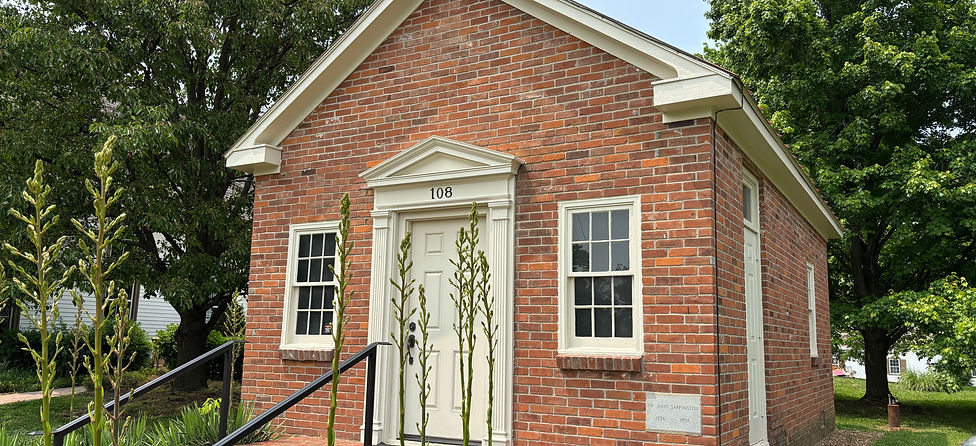
This brick building built in Greek Revival architecture honors Dr. John Sappington, entrepreneur and pioneer doctor. Dr. Sappington (1776-1856) was one of the first doctors to use quinine to treat fevers, especially malaria. A nonconformist, Dr. Sappington attacked the common practice of bloodletting and began treating patients with his own “Dr. Sappington’s Anti-Fever Pills.” In addition to his career as a medical doctor, he was a land speculator, a progressive agriculturalist, a money lender, and a political confidant in Jacksonian politics. We are indebted to the tireless efforts of the late Dr. Thomas B. Hall Jr. for the gift of the Sappington Museum.